

llamaMan
Manager for running multiple llama.cpp and Strata inference servers from one container: spawns sibling GPU containers via the Docker socket, Ollama/OpenAI-compatible API proxy with LRU model eviction, clustering, concurrency gating, multi-vendor GPU monitoring, and a built-in knowledge base with an MCP server.
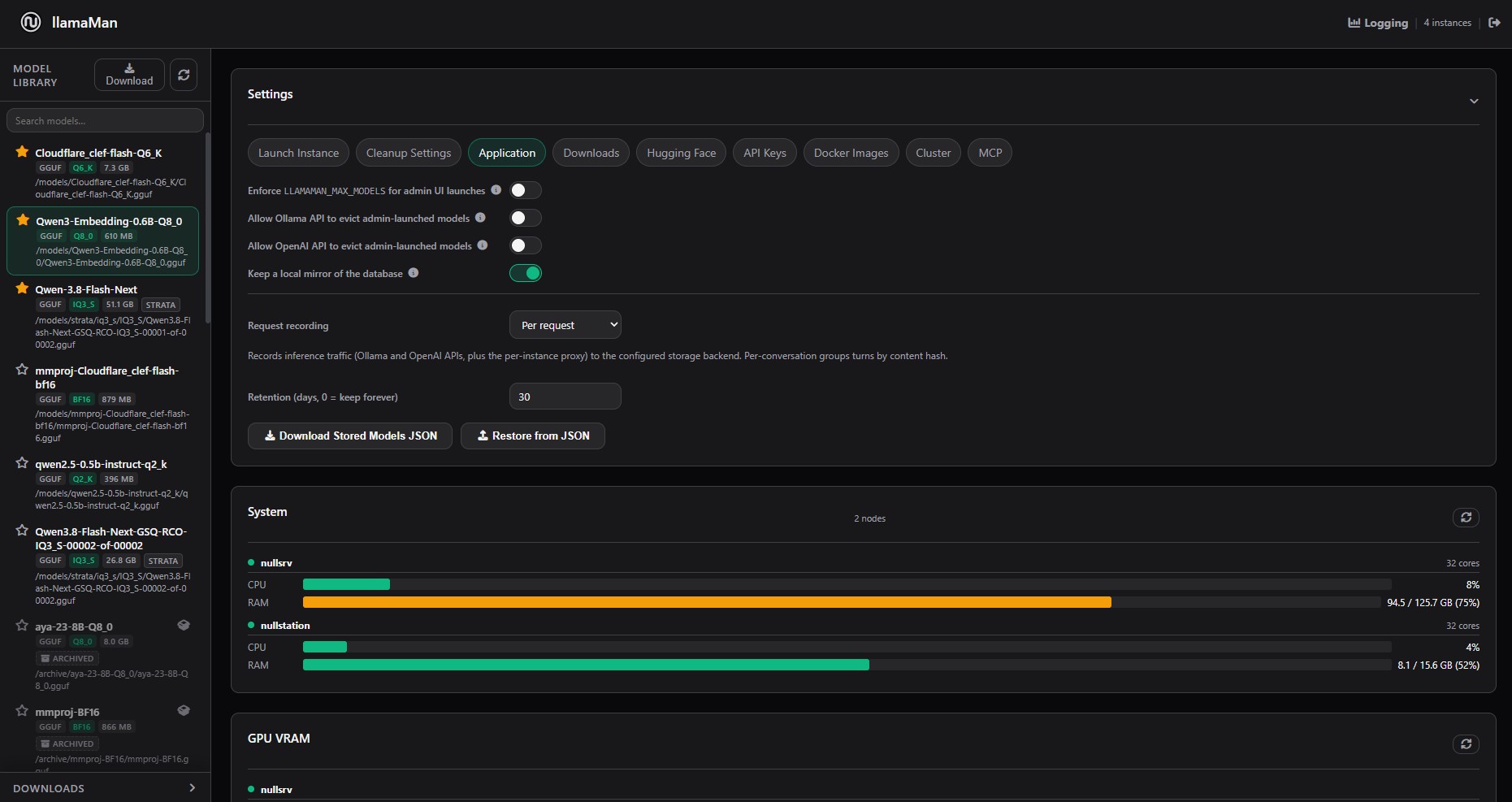
llamaMan is a browser-based UI for launching, monitoring, and managing multiple inference-server instances - llama.cpp and, opt-in, Strata - from inside a Docker container. Includes an Ollama-compatible API proxy so it works as a drop-in replacement for Ollama with Open WebUI, auto-starting models on demand and LRU-evicting them under a configurable cap. Compatible with any OpenAI API compatible client or agent harness.
Setup now via DockerHub
Features
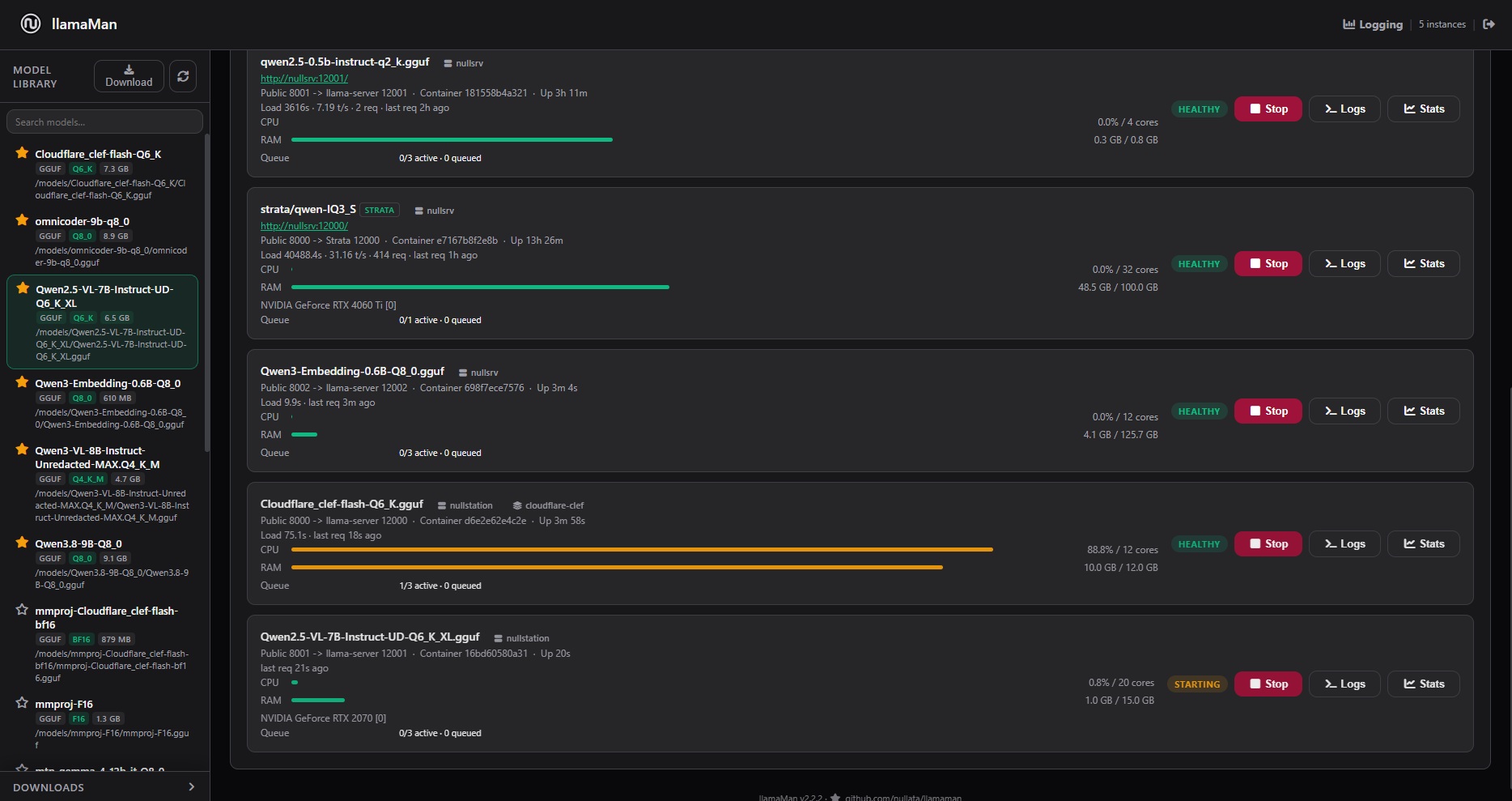
Flexibility and Scaling
- Launch and manage multiple llama.cpp server instances from a browser dashboard.
- Cluster multiple llamaMan nodes across your network: shared dashboard, cross-node launch and download, and shared-queue load balancing across heterogeneous hardware.
- Run models in isolated Docker containers with configurable GPU layers, context size, CPU threads, memory limits, parallel slots, GPU selection, and extra server flags.
- Use LlamaMan as a drop-in Ollama-compatible backend for Open WebUI and other Ollama clients.
- Serve OpenAI-compatible chat completions, model listings, and embeddings from local GGUF models.
- Auto-start models on demand when requests arrive, using saved presets or sensible defaults.
- Serve decision models - typed-question classifiers that answer with probabilities instead of text - on a dedicated /v1/systemone route with the same auto-start, routing, and eviction rules; chat endpoints refuse them cleanly.
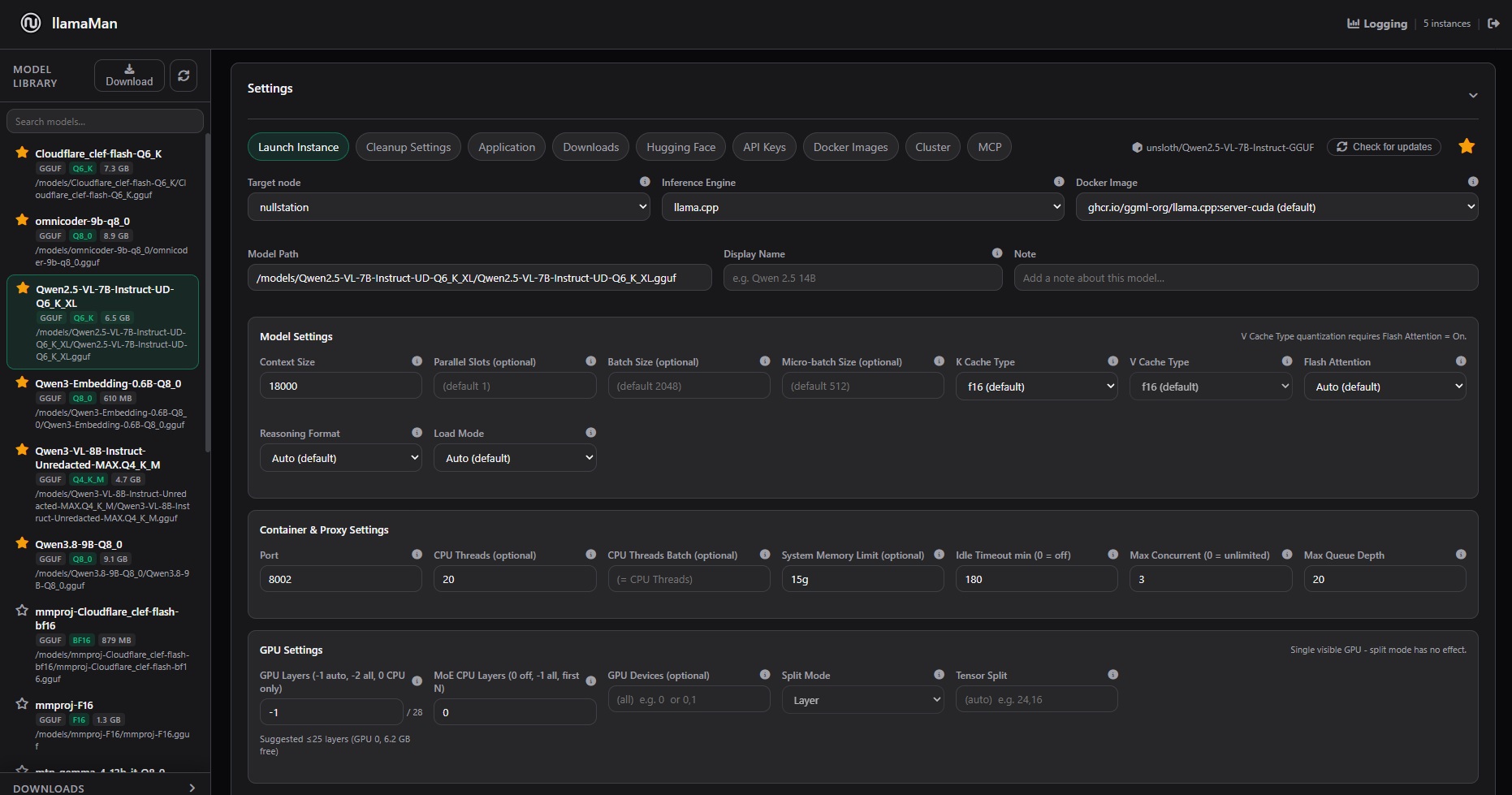
Resource Management
- Keep GPU memory under control with idle sleep, wake-on-request, and configurable model eviction limits (LRU).
- Save per-model launch presets, notes, favorites, and proxy-side sampling overrides for convenience and 2-click deployments.
- (new) Live preset updates: fields that don't need a relaunch (idle timeout, concurrency gates, sampling overrides, eviction exemption) apply to a running instance without restarting it.
- (new) Concurrency gating per instance: max concurrent requests and a bounded queue (429 past it), enforced by a per-instance proxy that also handles wake-on-request and model-name validation.
- (new) Exclude-from-cap flag per instance: embedding models, decision models, and
anything small can stay up permanently outside the
MAX_MODELScap.
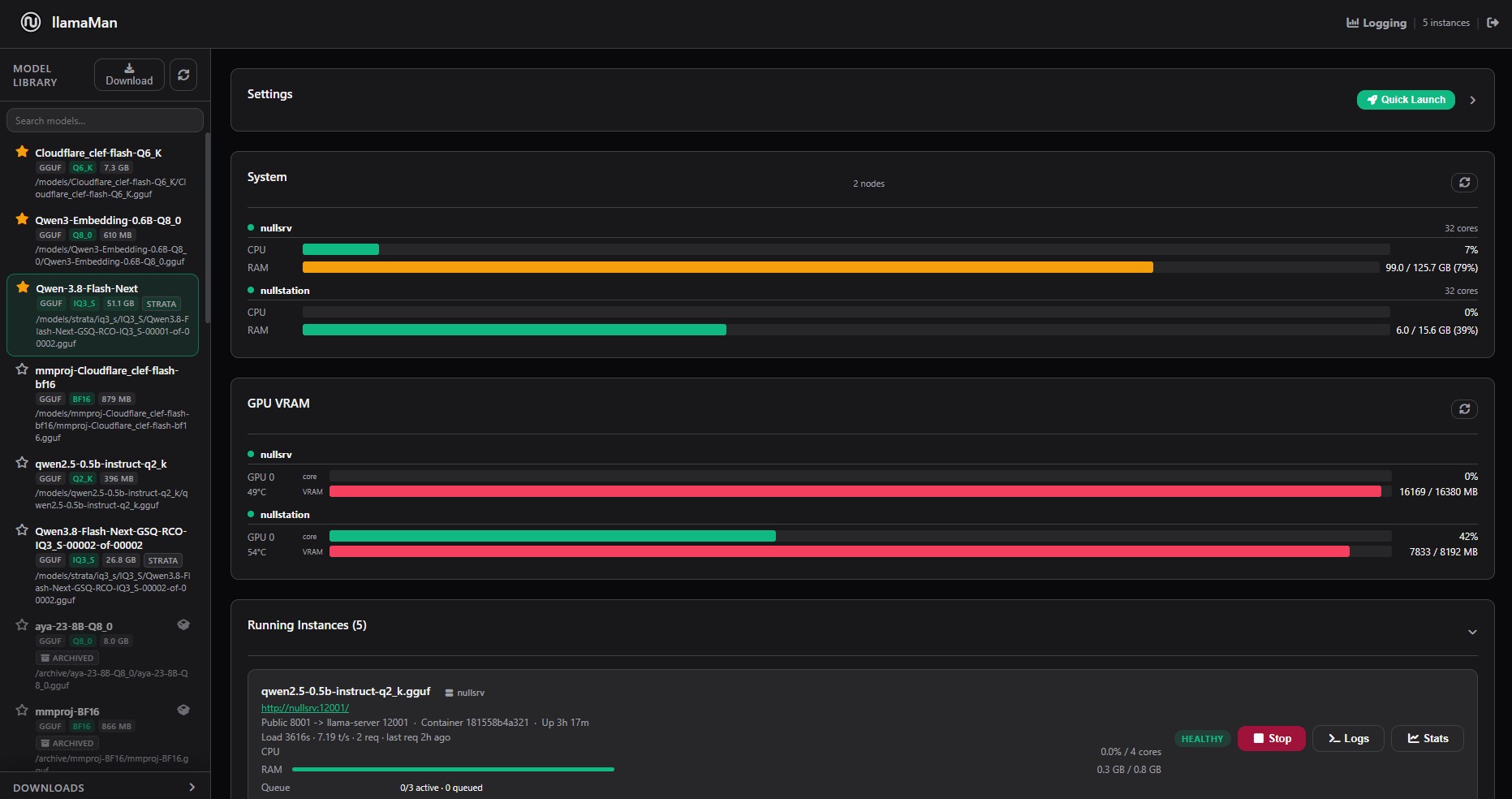
Monitoring
- Monitor every running model with live status, logs, load time, tokens per second, time to first token, request counts, CPU/RAM usage, and GPU assignment.
- View native GPU telemetry for NVIDIA, AMD, Intel Arc, and (opt-in) Vulkan, including VRAM, utilization, and temperature.
- (new) Opt-in request recording - per-request or per-conversation, with retention - feeding a logging dashboard; the same request log rolls up the throughput/TTFT/latency stats.
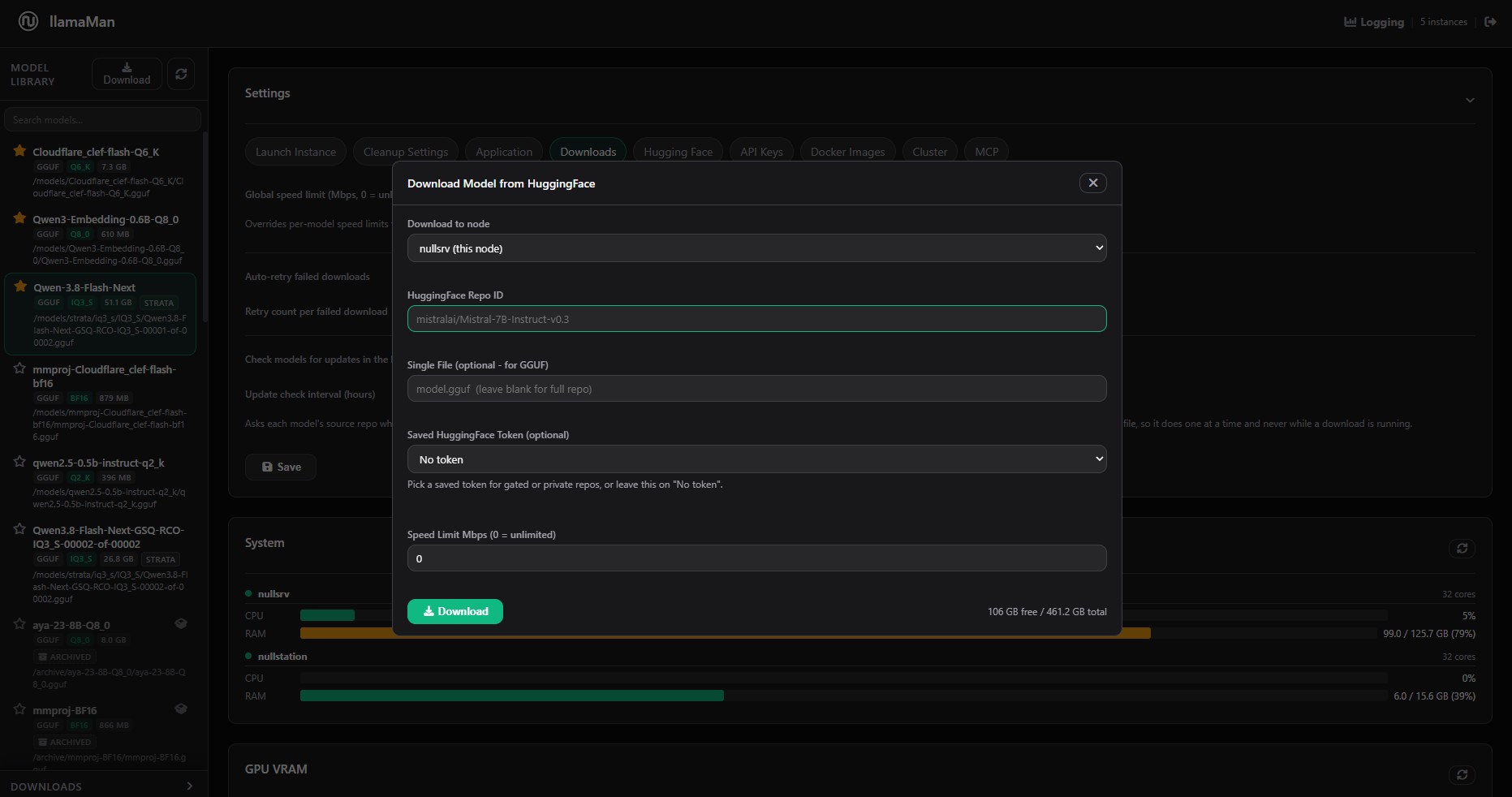
Downloads
- Download GGUF models directly from Hugging Face with progress tracking, pause/resume, retry, cancellation, saved tokens, and per-node speed limits.
- (new) Republish detection: compare a local model against its source repo's content hash and atomically re-pull on update - a failed pull never touches the working file.
- (new) Model archive: move rarely used models to a second volume and restore them later; moves run as cancellable jobs, are atomic across disks, and presets, favorites, and notes survive the round trip.
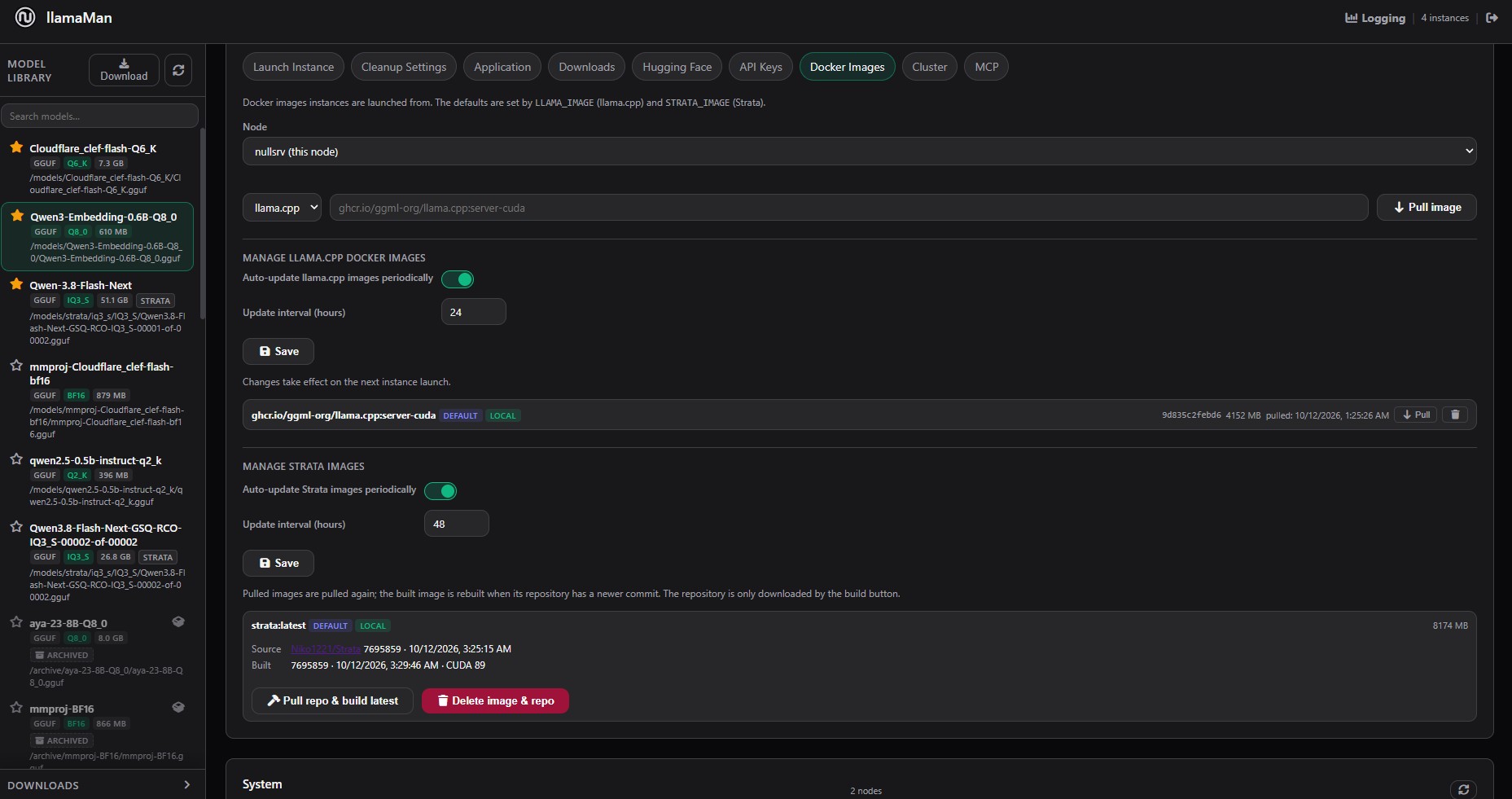
- (new) Docker image management from the UI: pull newer llama.cpp
server-*images (update the engine without touching llamaMan), pull any image by name, and build or delete Strata images. - Download models based on settings from other cluster nodes.
Security
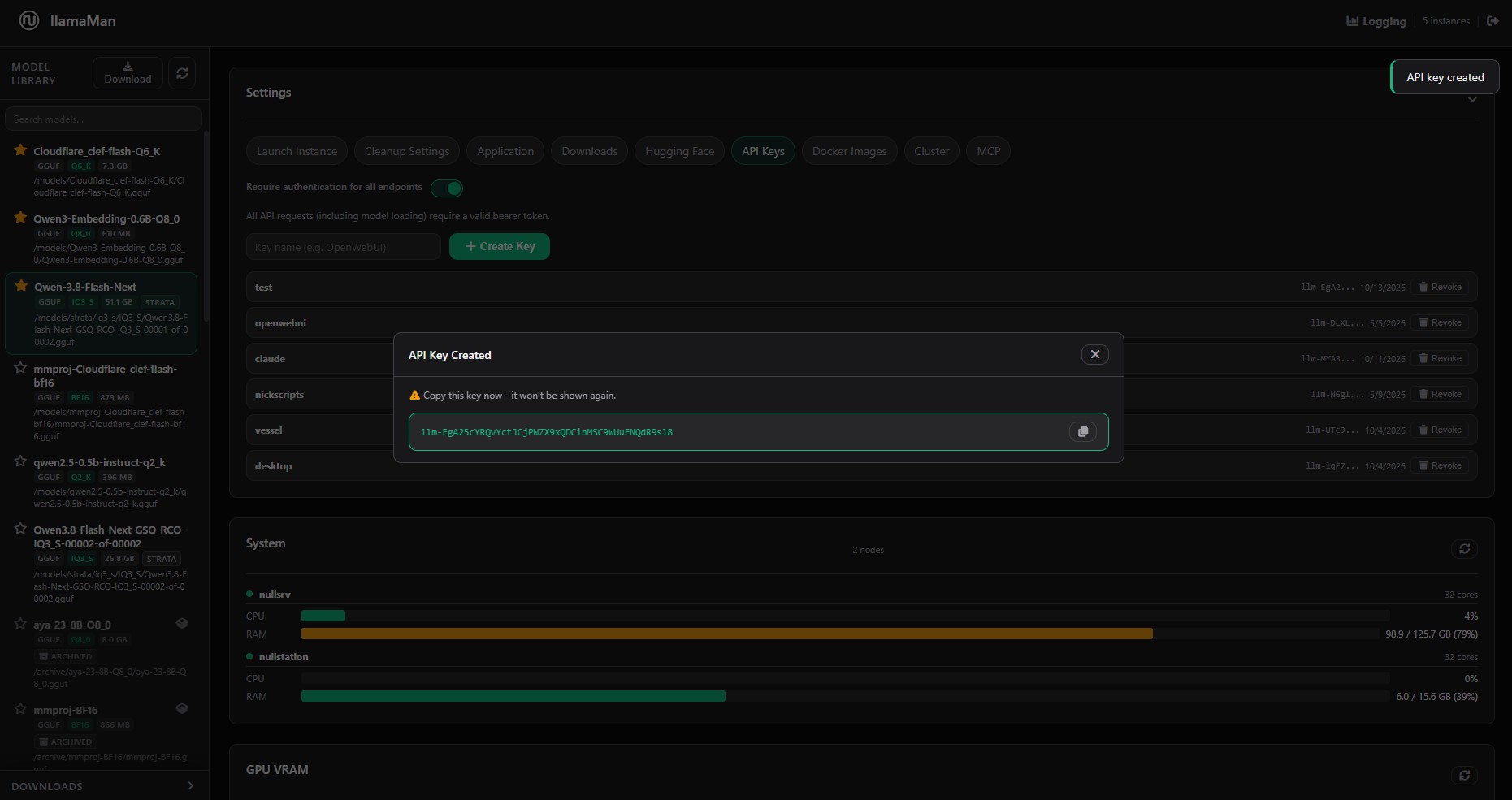
- Protect the dashboard and model APIs with first-run admin setup and session login.
- API keys support, and optional bearer-token enforcement for all serving endpoints.
- (new) Per-API-key scoping for the knowledge base (private topics per key).
Inference Engines
- Run llama.cpp and Strata instances side by side: an engine picker per launch, with each instance's engine stored alongside it.
- Strata (opt-in, NVIDIA) runs the Qwen3.8-Flash-Next MoE family on consumer NVIDIA GPUs plus system RAM - models that don't fit in VRAM alone. Launched, monitored, proxied, slept, and woken with the exact same machinery as llama.cpp.
- Strata images built or pulled from the UI (built for the node's GPU generations); multi-gigabyte shard sets pre-downloaded through llamaMan's own downloader with progress, pause/resume, and retry.
- Engine-agnostic by design: the launch path for llama.cpp is snapshot-tested byte-for-byte, so adding an engine never changes existing behavior.
Advanced Serving
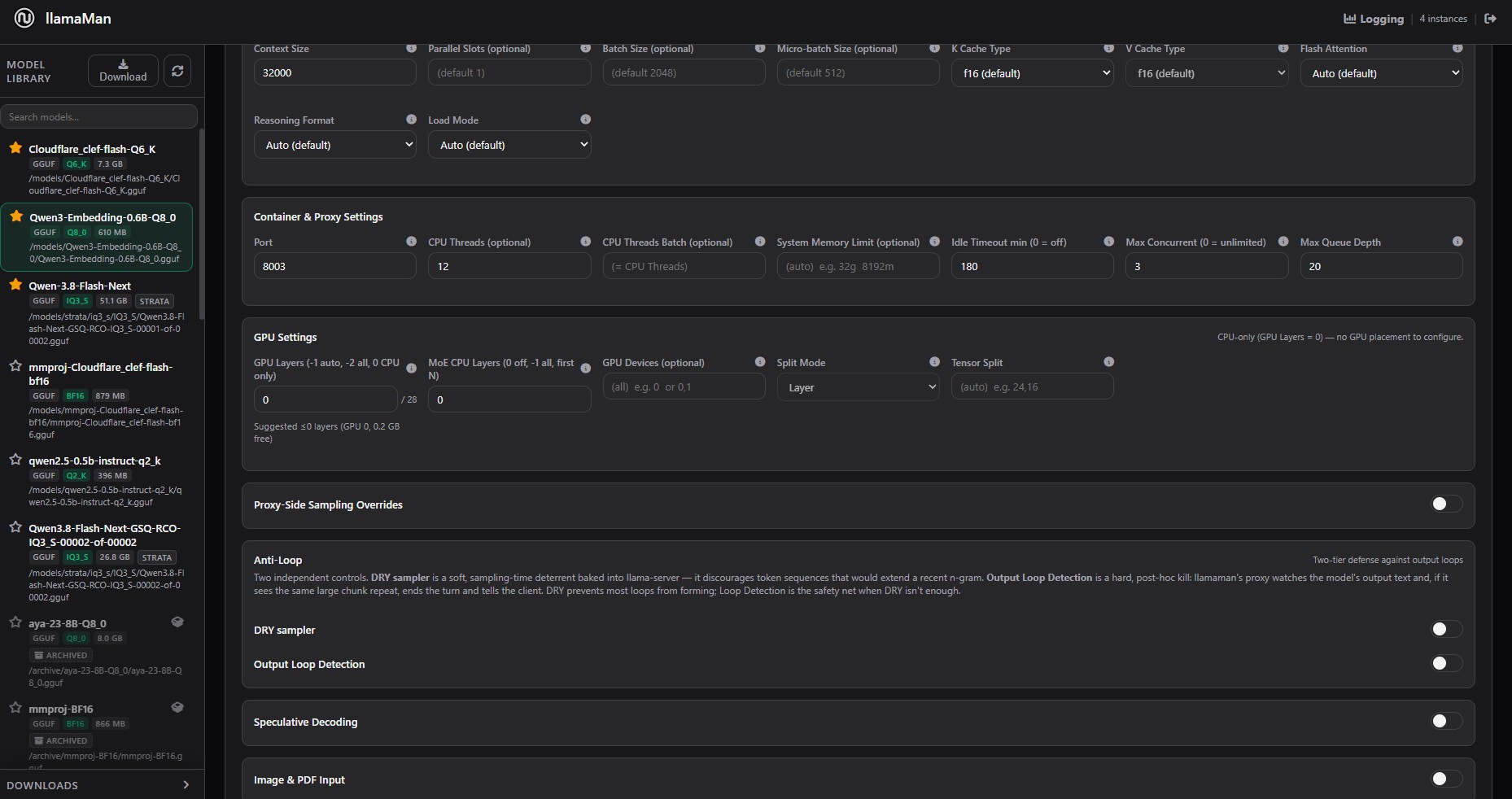
- Speculative decoding with all five llama.cpp draft families (simple, MTP, dflash, dspark, eagle3) and the advanced acceptance knobs.
- MoE CPU offload (
--cpu-moe/--n-cpu-moe): shrink big-MoE VRAM usage several-fold by pinning routed experts to system RAM. - Flash attention, KV-cache quantization, reasoning-format, and load-mode (mmap/mlock/dio) as first-class launch fields, with the UI enforcing flag constraints.
- Image & PDF input: vision models via
--mmproj, and PDFs rasterized page-by-page - working through both OpenAIimage_url/fileand Ollamaimages[]. - Anti-Loop protection: a DRY sampler at sampling time plus proxy-side output-loop detection that hard-stops a turn when the streamed text starts repeating.
- Embedding models flagged at launch, exempt from the concurrent-model cap and never evicted, so RAG clients always have them warm.
Knowledge Base & MCP
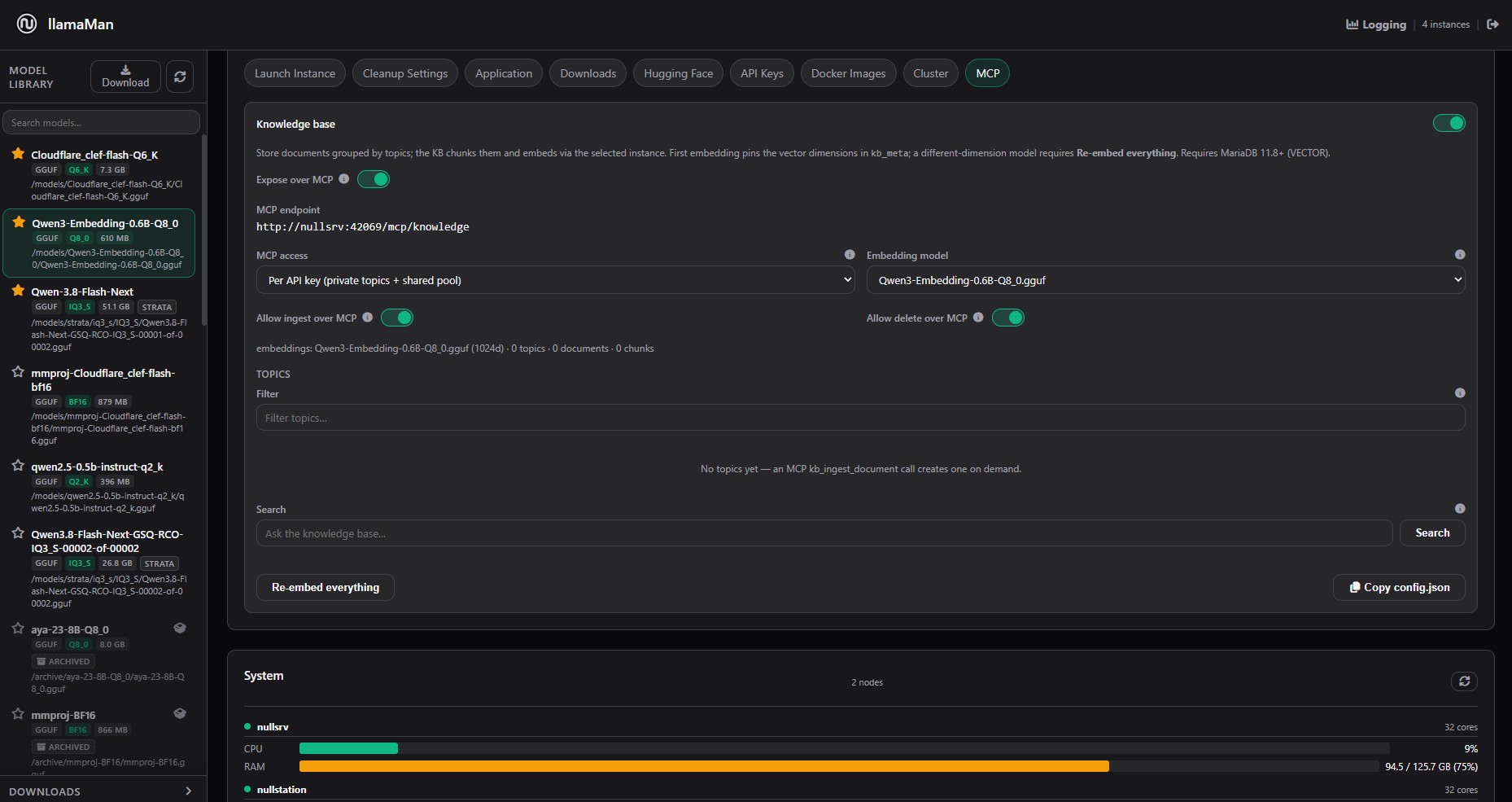
- Opt-in knowledge base (MariaDB backend): store documents grouped by topic; llamaMan chunks them, embeds them with a local embedding model you already run, and keeps the vectors in your database with a cosine ANN index.
- Semantic search exposed to any MCP client (Claude Desktop, Claude Code, agents) at
/mcp/knowledge- with a ready-to-paste client config from the UI. - Access modes: a shared pool for everyone, or a private knowledge base per API key alongside a read-only shared pool.
- Everything local: embeddings, vectors, and the MCP server all run on hardware you already run.
Storage & Resilience
- Persistent state in plain JSON files by default - zero database dependency for single-node installs.
- MariaDB/MySQL backend unlocks clustering, the knowledge base, and request recording.
- Optional local write-through mirror keeps a node serving through a database outage.